

Παρουσίαση έργου | Project in brief
nAngioDerm: European Grant for 3D Printed Skin and Wound Care
The regenerative medicine project nAngioDerm has received a European grant of €747,000 ($822,000) to provide a solution for dermal regeneration, by helping patients whose wounds from ulcers or major burns fail to heal. The funding will go to five European institutions and companies collaborating on the project, which is coordinated by the Institute for Bioenginnering of Catalonia, in Spain, and partnered by Microlight3D, the University of Ioannina, Department of Agriculture, Greece; the Hospital Universitario Valld’Hebrón (HUVH), Spain, and the Universitè Grenoble Alpes, France.
According to studies, skin diseases continue to be the fourth leading cause of nonfatal disease burden world-wide. Each year, more than 305 million acute, traumatic and burn wounds are recorded and treated globally. Wound care is associated with significant costs and has become a major challenge to healthcare systems worldwide, in the United States, Medicare spends at least $32 billion and maybe as much as $96.8 billion annually on wound treatment. While a UK study on the health outcomes, resource implications and associated costs attributable to managing wounds in the 2012/2013 period estimated the annual cost to the UK’s NHS (National Health Service) in managing wounds to be over £4.5 billion ($5.5 billion).
To better deal with this global problem, the partners will develop a new process and new products involving ion-release bio-materials which will promote angiogenesis for dermal regeneration. This demands skilled competencies in tissue engineering, bio-active ions, and cell-scaffold 3D-printing.
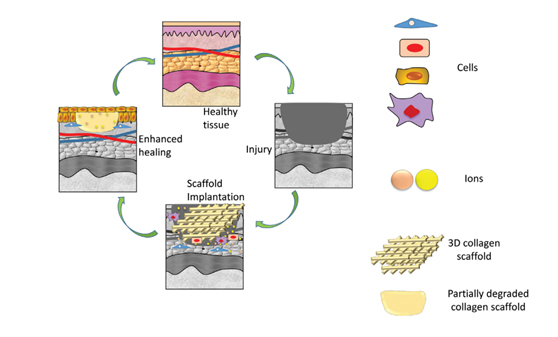
nAngioDerm will develop nanostructured
ion-release platforms
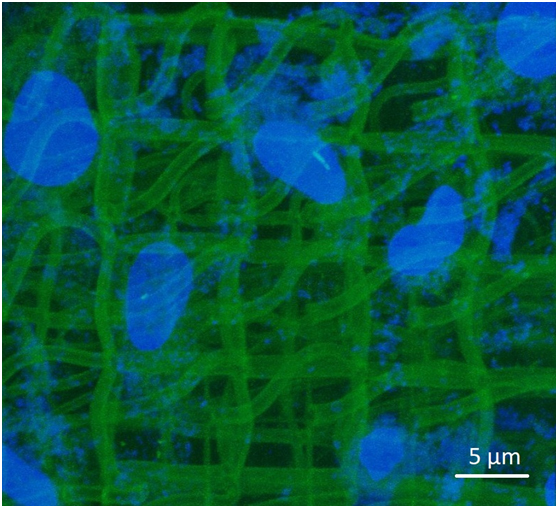
3d printed collagen structure
for cell culture Confocal Fluorescence Microscopy
he nAngioDerm initiative falls within the scope of EuroNanoMed3 (2016-2021), which supports multidisciplinary and translational research and innovation projects covering regenerative medicine, diagnostics, and targeted delivery systems, under the European Horizon 2020 program, which is the biggest EU Research and Innovation programme to date with nearly €80 billion of funding available over a seven-year period ending in 2020. Working to promote European innovative research and technological development projects in nanomedicine, EuroNanoMed3 is funding 12 successful consortia with a total €9 million for three years, and a total of 57 research groups from 13 participating countries.
The comprehensive nAngioDerm project will equip researchers with a transferable and multidisciplinary skill set to enable them to adapt quickly to the challenging needs of the Medtech sector and to afford them rapid ascent to key leadership positions in the field. In the long-term, the technologies developed will be implemented in other clinical areas, resulting in increased European-based knowledge, innovation, competitiveness and leadership in the field.
Recent Advances in Collagen Antimicrobial Biomaterials for Tissue Engineering Applications

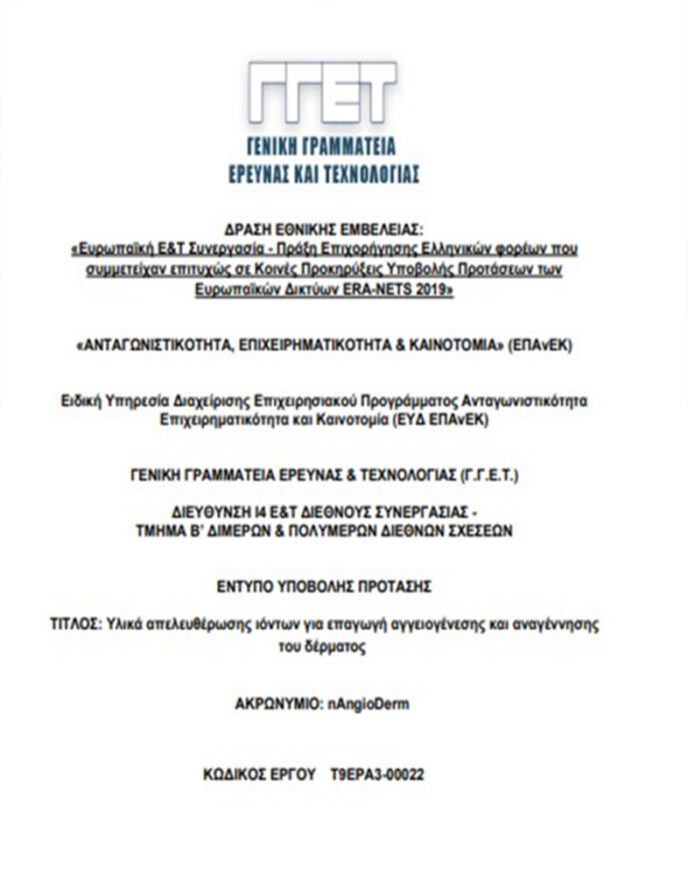
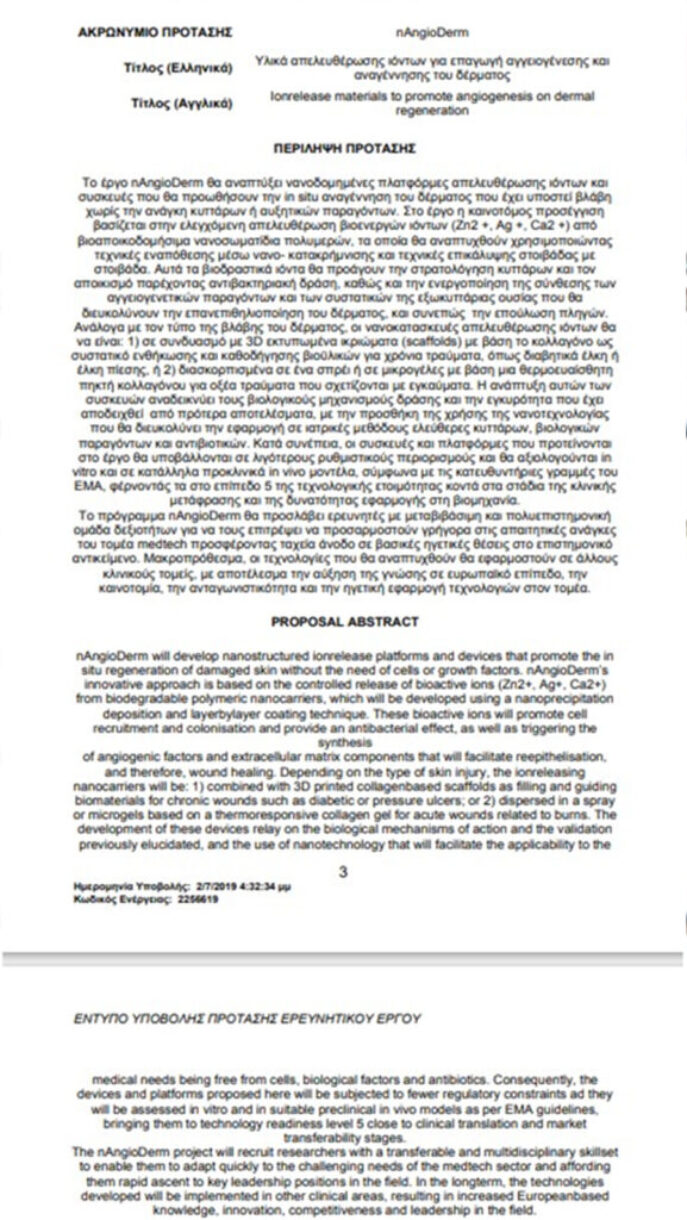
Partners involved in the project nAngioDerm
1. Leader: Biomaterials for regenerative therapies / INSTITUTE FOR BIOENGINEERING OF CATALONIA, SPAIN (IBEC)
2. Department of Plastic Surgery and Burns / HOSPITAL UNIVERSITARIO VALL D’HEBRON (HUVH)
3. LIPhy (Lab for Interdisciplinary Physics) / UNIVERSITÉ GRENOBLE ALPES (UGA)
4. MICROLIGHT3D SAS (ML3D)
5. UNIVERSITY OF IOANNINA (UOI)
PROJECT GRANT:
IBEC: 190,000 €
UOI: 198,560€
HUVH: 149,435 €
UGA: 88,992 €
ML3D: 33,000 €
ANAΠΤΥΞΗ ΤΟΥ ΕΡΕΥΝΗΤΙΚΟΥ ΕΡΓΟΥ
WP1 – Fabrication of MetalIonLoaded nanoCarriers (MILnCs) (Responsible IBEC, HUVH) Aim: The design of MILnCs for the controlled release of specific ions involved in angiogenesis, chemotaxis, reepithelialisation and with antibacterial properties: Ca2+, Zn2+, Ag+.
Task 1.1. Development and optimisation of MILnCs by nanoprecipitation technique and LbL (Responsible IBEC)
Task 1.2. Production of MILnCs and quality control (Responsible IBEC)
WP2 – 3D Composite collagen-based scaffold fabrication for chronic ulcers treatment (Responsible ML3D, UGA, IBEC)
Task 2.1. Optimisation of 3D printing inks (Responsible UGA, HUVH)
Task 2.2. Fabrication of scaffolds by 3D printing (Responsible ML3D)
Task 2.3. Development of new tools to speed up the fabrication of large 3D architectures (Responsible ML3D, UGA)
WP3 – Fabrication of collagen based devices for first burned skin treatment (Responsible UOI, IBEC, HUHV 48 months)
T3.1. Development of thermos responsive microgels / spray formulations (Responsible UOI, IBEC, HUVH)
WP4 – Characterisation and loading of the MILnCs and collagen based 3D constructs and thermoresponsive sprays/microgels (Responsible UOI, IBEC, HUHV)
Task 4.1. Physicochemical characterisation of MILnCs, 3D constructs and thermoresponsive sprays/microgels (Responsible UOI, IBEC, ML3D)
Task 4.2. Evaluation of the loading efficiency and ion release of MILnCs, 3D constructs and thermoresponsive sprays/microgels (Responsible IBEC, UOI, HUVH)
Task 4.3. Optimisation of the sterilisation of 3D constructs and thermorresponsive spray/microgels (Responsible IBEC, UOI, HUVH)
WP5 – In vitro studies of collagen based 3D constructs and thermoresponsive sprays/microgels (Responsible IBEC, UOI, HUHV)
Task 5.1. Evaluation of the cytocompatibility of the developed devices (Responsible UOI, IBEC, HUVH)
Task 5.2. ECM secretion (IBEC)
Task 5.3. Investigation of the proangiogenic efficacy of the developed systems (Responsible IBEC, HUVH)
Task 5.4. Evaluation of the antibacterial activity of the different MILnCs (Responsible IBEC)
Task 5.5. Analysis of the antimicrobial device treatment effect in an in vitro wound biofilm model (Responsible IBEC, HUVH)
WP6 – Validation of 3D scaffolds by human skin equivalent in vitro model (Responsible UOI, HUVH)
Task 6.1. Engineering of a human skin equivalent in vitro model (Responsible HUVH, UOI)
Task 6.2. Validation of collagen based 3D constructs in injured human skin equivalent. (Responsible UOI, HUVH)
WP7 – In vivo assessment per ISO / EU regulatory requirements (Responsible HUVH, UOI, IBEC)
Task 7.1. Preclinical validation in a pig model (Responsible HUVH, IBEC)
Task 7.2. Dossier preparation for first in man clinical trials following the end of the project (Responsible HUVH, IBEC, UOI)
WP8. Management and RRI implementation (Responsible IBEC, All)
Task 8.1. Meeting organization (Responsible IBEC)
Task 8.2. Scientific and administrative management (Responsible IBEC, All)
Task 8.3. Dissemination and communication plan (Responsible IBEC, All)
Task 8.4. Exploitation plan (Responsible ML3D, IBEC)
ΣΥΝΘΕΣΗ ΚΥΡΙΑΣ ΕΡΕΥΝΗΤΙΚΗΣ ΟΜΑΔΑΣ ΚΑΤΑ ΤΗΝ ΑΞΙΟΛΟΓΗΣΗ:
ΦΟΡΕΑΣ UNIVERSITY OF IOANNINA
UOI SKOUFOSIOANNISVETERINARIANANIMALHEALTH
UOI ZEUGOLIS DIMITRIOS BIOMEDICAL ENGINEER/BIOMATERIALS
UOI TZORA ATHINA VETERINARIAN, MICROBIOLOGY
UOI BONOS ELEFTHERIOS VETERINARIAN ANIMAL NUTRITION
UOI TSINAS ANASTASIOS VETERINARIAN ANIMAL INTERNAL MEDICINE
UOI MARETAS DIMITRIOS HEAD OF THE RESEARCH OFFICE
UOI FOTOU KOSTANTINA ANIMAL SCIENTIST
UOI GOUVA EVANGGELIA ANIMAL SCIENTIST
UOI MAGKLARAS GEORGIOS ANIMAL SCIENTIST
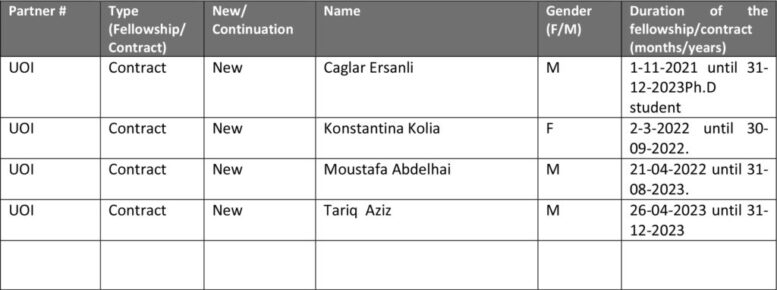
Νumber of jobs created within the framework of the current project BY UOI
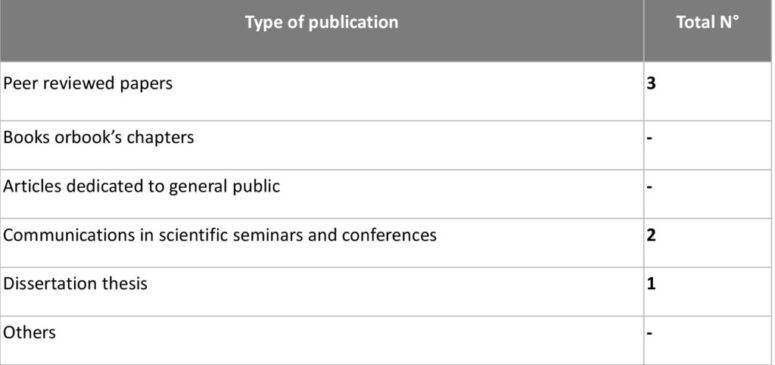
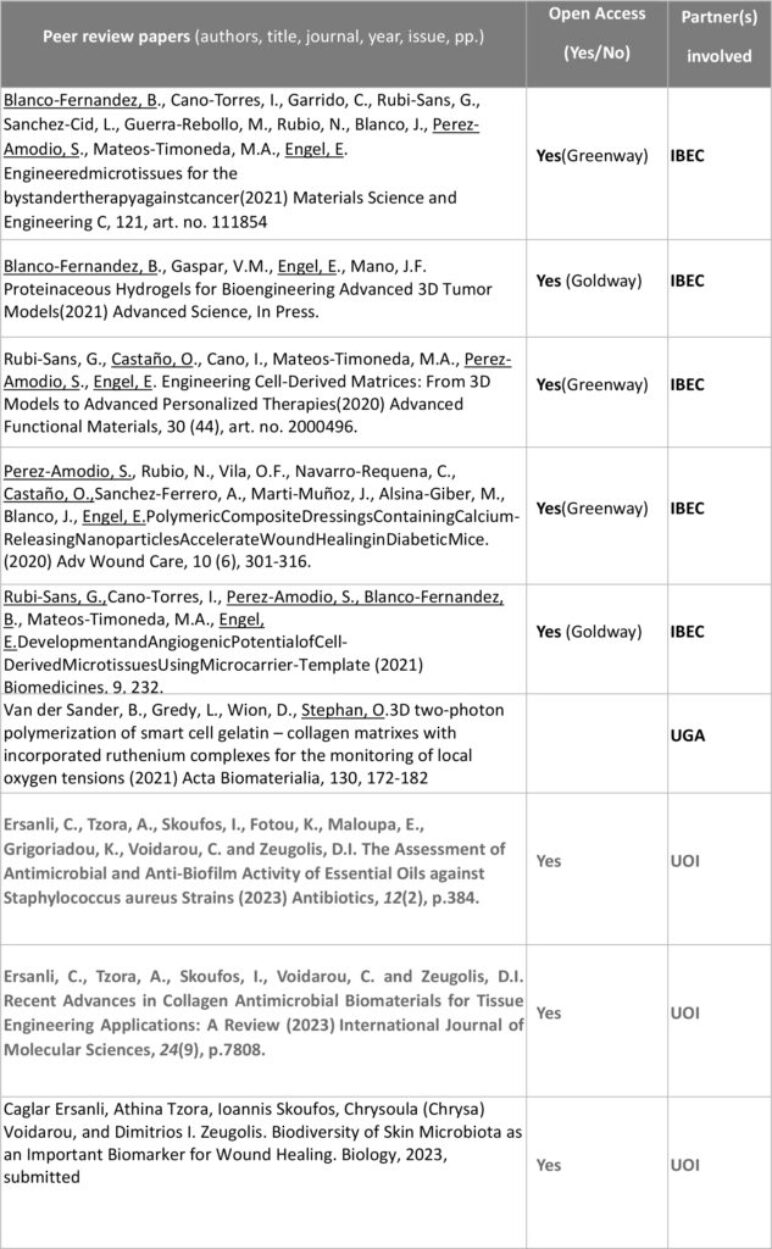
Number of publications, communications and dissertations related to the results of your EuroNanoMed project from UOI side.
Communications in scientificmeetings

The Assessment of Antimicrobial and Anti-Biofilm Activity
of Essential Oils against Staphylococcus aureus Strains
Recent Advances in Collagen Antimicrobial Biomaterials
for Tissue Engineering Applications:
A Review
Pharmacokinetics, antimicrobial and biological properties
of essential oil-loaded collagen hydrogels
UK Society for Biomaterials